
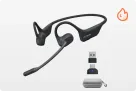
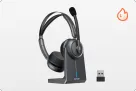
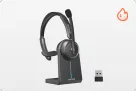

























Sealed and noise-canceling headphones cause the classic work-from-home problem: missed doorbells, unheard kids, and family members who feel ignored.
Open-ear headphones solve it by leaving your ear canal open, piping music in while ambient sound passes through naturally.
Key Takeaways
Open-ear headphones sit outside the ear canal, so music and household sounds reach you at the same time — no transparency mode required.
If more than half your workday is video calls, prioritize microphone quality and consider a noise cancelling headset for meetings, with open-ear for focus hours.
Bone conduction and air conduction are the two open-ear designs.
- Air conduction sounds fuller.
- Bone conduction works better with earplugs or hearing considerations.
Keep open-ear volume moderate — they leak sound at high levels, which matters if someone else works in the same room.
Music makes remote work bearable — it fuels focus, breaks the silence, and makes the home office feel less lonely.
But anyone who has worked from home with headphones on knows the other side of the deal:
- The courier leaves your package on the step because you never heard the bell.
- Your partner has waved at you three times before giving up.
- Your kid has been standing next to you for a full minute.
Headphones open ear designs exist precisely to end this trade-off.
This guide explains why traditional headphones create the problem, how open-ear technology solves it, and how to pick the right setup for your workday.
Why Wearing Headsets While Working Can Be a Dilemma
Working from home is a constant negotiation between two needs.
- On one side: concentration. Background music or a podcast genuinely helps many people enter flow state, and a good work from home headset is essential for the meetings that fill a remote calendar.
- On the other side: presence. Home is not an office — it contains family members who need you, deliveries that need signing for, smoke alarms, barking dogs, and simmering pots.
The dilemma is that the better most headphones are at their primary job, the worse they make you at being reachable.
Every decibel of isolation you gain is a decibel of your home life you miss. Remote workers end up in an absurd routine: headphone on, headphone off, one earcup half-lifted "just in case," all day long.
How Traditional Headphones Can Disconnect You from Your Surroundings
Most work headphones fall into two categories, and both isolate you by design:
- Closed-back and in-ear headphones physically seal your ear canal or surround your ear, blocking household sound through passive isolation alone.
- Noise-canceling headphones go further, using microphones and anti-noise to electronically erase low-frequency sounds — the hum of the house, and unfortunately often the doorbell chime too.
Transparency or "ambient pass-through" modes promise a fix, piping outside sound back in through the microphones.
In practice, the sound is delayed, tinny, and unnatural. The disconnection is social as much as acoustic.

Can You Stay Focused Without Completely Blocking Out Background Noise?
What breaks concentration is not the existence of background noise but unpredictable, unattended noise — the kind you cannot monitor and must either ignore anxiously or investigate.
That reframing is why ambient sound headphones have emerged as a category of their own. Instead of erasing your environment, they keep it audible at a manageable level while layering your audio on top. You hear the delivery van pull up as it happens, not thirty minutes later in a missed-delivery notification
Your brain relaxes because nothing is being hidden from it — and relaxed attention is exactly what deep work needs.

What Are Open-Ear Headphones and How Do They Work?
Open-ear headphones are the purest expression of that idea.
Unlike every traditional design, nothing enters or covers your ear canal. Sound reaches your eardrum while the ear remains physically open to the world, so household audio arrives naturally—unprocessed, undelayed, in full fidelity.
Two technologies dominate the category:
Air conduction
Small directional speakers sit just outside the ear canal (on an ear clip or a band above the ear) and beam sound toward it. These tend to sound fuller, with more present bass.
Bone conduction
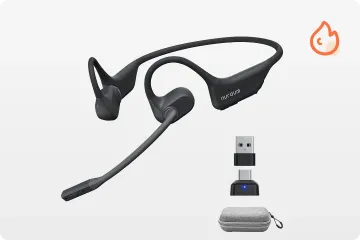
Transducers rest on your cheekbones and transmit vibration through the skull directly to the inner ear. The ear canal stays completely untouched — a benefit for anyone who finds in-ear tips painful or wears hearing aids.
How to Choose the Best Headphones Without Missing a Thing
Match the gear to your actual workday mix:
Mostly focus time, few calls
An open-ear model is your primary device.
Prioritize all-day comfort (look for under 30g or a soft ear-clip fit), 8+ hours of battery, and physical buttons you can hit without looking.
Noisy household
If your challenge is blocking out chaos during deep-focus sprints, keep a noise cancelling headphone for work for those windows and use open-ear the rest of the day.
Shared workspace at home
If a partner or roommate works in the same room, keep open-ear volume around half; beyond that, leakage becomes audible.
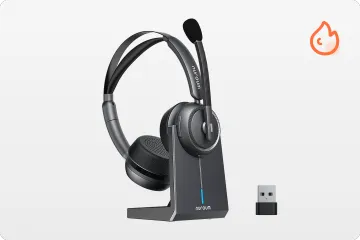
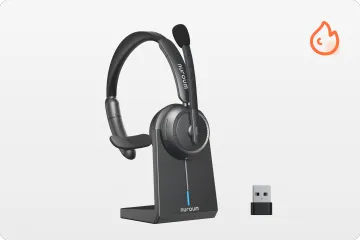
For truly silent coexistence, an noise cancelling headphone with mic is the polite choice.
The pattern:
- Open-ear covers the 80 percent of the day when you want music and awareness
Specialized headsets handle the 20 percent where call quality or isolation is non-negotiable.

FAQs
1.Are headphones open ear designs good for working from home?
Yes.
Arguably the best design for it. Nothing seals or enters your ear canal, so music and household sounds arrive together. The trade-offs (lighter bass, mild leakage at high volume) rarely matter in a private home office.
2.Can I use open-ear headphones for video calls and meetings?
Most handle casual calls fine.
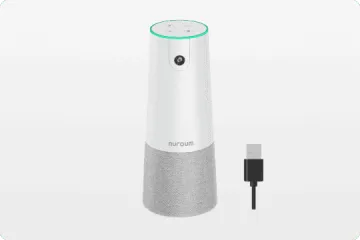
For meeting-heavy days, choose a model with a noise cancelling microphone — or pair open-ear listening with a dedicated work from home headset for calls.