









































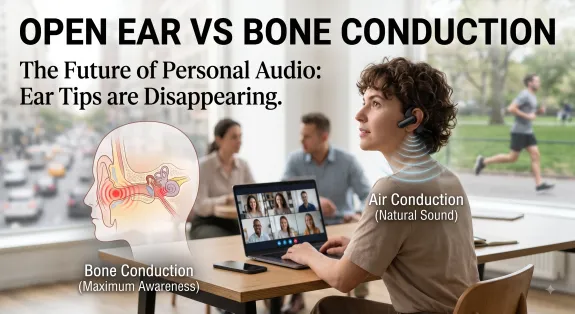
Open-ear and bone conduction headphones both let you hear your surroundings—but they do it in completely different ways. So which one delivers better sound, comfort, call quality, and everyday usability? This guide breaks down the technology behind both designs and compares them across the features that matter most. You’ll also see why open-ear air conduction has become a versatile choice for calls, commuting, work, and daily listening, with the Nuroum OpenEar Pro 2 offering a closer look at what modern open-ear headphones can do.
Key Takeaways
- Understand the key differences between open-ear and bone conduction headphones, including how each technology delivers sound.
- Compare sound quality, comfort, situational awareness, call quality, battery life, and price to determine which design fits different everyday needs.
- Learn why open-ear headphones can offer better sound and bass while keeping the ear canal open and allowing you to stay aware of your surroundings.
- Understand the difference between ANC and ENC and why microphone-side noise cancellation is especially important for clear calls in noisy environments.
- See how the Nuroum OpenEar Pro 2 combines open-ear comfort, ENC call clarity, multipoint connectivity, and all-day battery life for everyday use.
Walk into any electronics store or scroll through a headphone review site today, and you will notice the same shift: ear tips are disappearing. More people are choosing headphones that do not plug, seal, or press into the ear canal. Two designs dominate this category — open-ear headphones and bone conduction headphones. Both promise to keep you aware of your surroundings while delivering music, podcasts, and calls. But they work in fundamentally different ways, and that difference matters for everything from sound quality to all-day comfort.
If you have been searching for an open ear headphone with mic that lets you stay present during calls without blocking out the world, or if you are simply trying to decide between open-ear and bone conduction for your daily routine, this guide breaks down what each technology actually does, how they compare, and which one fits your life. For many people, the search starts with finding a work from home headset with noise cancelling microphone that does not force them to choose between hearing their surroundings and being heard clearly — and that is exactly where open-ear and bone conduction designs shine.
What Are Open-Ear Headphones?
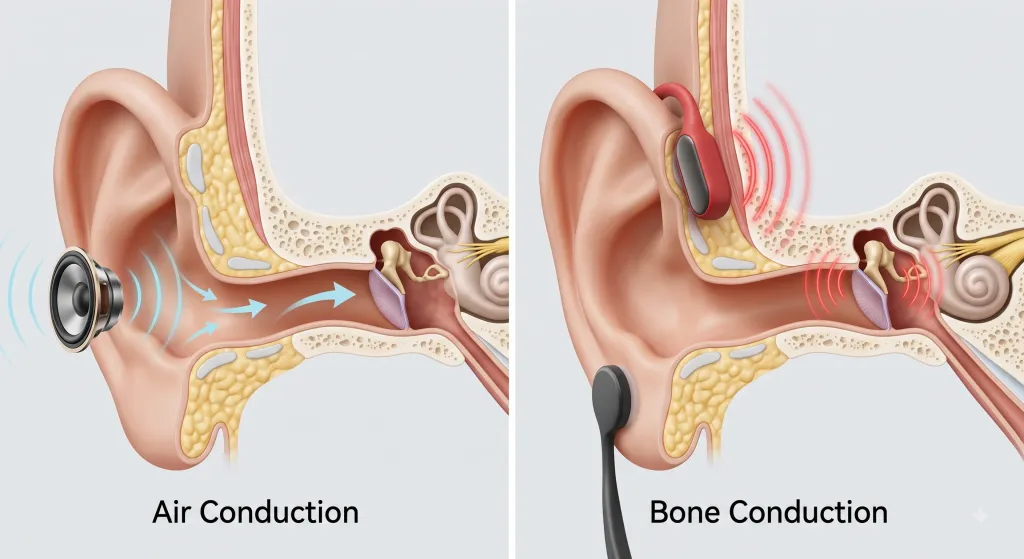
Open-ear headphones — sometimes called open-ear air conduction headphones — use a miniature speaker driver positioned just outside your ear canal. An ear-hook or clip-on frame holds the driver in place without inserting anything inside the ear. Sound travels the short gap of air into your eardrum, exactly the way natural hearing works.

The key advantage is that your ear canal stays completely open. A wireless open ear headphone lets you hear your music or take a call while still catching a colleague asking a question, a doorbell ringing, or traffic approaching. Advanced models use directional audio and beamforming technology — essentially focusing sound toward your ear like a narrow beam rather than broadcasting in all directions. This significantly reduces sound leakage, so people nearby cannot hear your audio at normal volumes.
Popular open-ear models in 2026 include the Bose Ultra Open Earbuds, Shokz OpenFit 2, Huawei FreeClip 2, and the Nuroum OpenEar Pro 2, which we will cover in detail later.
What Are Bone Conduction Headphones?
Bone conduction headphones take a completely different approach. Instead of a speaker moving air, they use transducers — small vibrating pads that rest against your cheekbones or temples. These transducers convert audio signals into mechanical vibrations, which travel through your cranial bones directly to the cochlea in your inner ear. The eardrum is bypassed entirely.

This is not a gimmick — bone conduction is the same principle behind how you hear your own voice when you speak. What makes it practical for headphones is that it leaves your ear canals completely free to hear ambient sound. For runners, cyclists, and anyone who needs maximum environmental awareness, a bone headset bluetooth design offers a distinct safety advantage.
The market leader in this category is Shokz (formerly AfterShokz), with the OpenRun Pro 2 as their flagship. That model introduced a hybrid approach called DualPitch technology, combining bone conduction for mid and high frequencies with a small air conduction driver for bass — a sign that even the bone conduction category recognizes the bass limitations of pure vibration-based audio.
Open-Ear vs. Bone Conduction: How Do They Work?
The fundamental difference comes down to the physical pathway sound takes to reach your brain:
Open-ear (air conduction): Speaker → air → eardrum → middle ear bones → cochlea → auditory nerve
Bone conduction: Transducer → cheekbone vibrations → skull bones → cochlea (bypassing eardrum) → auditory nerve
Both achieve the same goal — keeping your ears open to the world — but they use different physics. Air conduction is more efficient for transmitting a full frequency range, especially bass. Bone conduction is inherently less efficient at moving air, which is why it has historically struggled with low-end reproduction at the same price point.
Open-Ear vs. Bone Conduction: What's the Difference?
Here is how the two designs compare across the dimensions that matter most in daily use:
Sound quality. Open-ear air conduction wins on overall fidelity and bass response. Large drivers with DSP tuning can reach down to around 40 Hz with a natural, full-bodied sound. Bone conduction typically rolls off around 50 Hz, and the bass lacks the physical "thump" sensation that air conduction delivers. Bose states plainly: "Air conduction is far superior to bone conduction for sound quality, especially if you want to enjoy a thumping bass."
Comfort. Both are excellent for long wear since neither enters the ear canal. Bone conduction uses a wraparound neckband that distributes weight across the head — comfortable for hours but can produce a tickling vibration sensation at high volumes. Open-ear ear-hook designs weigh as little as 4-6 grams per side but may pinch small ears after extended sessions. The Nuroum OpenEar Pro 2, at just 31 grams total, is among the lightest in its category.

Situational awareness. Both keep the ear canal open. Bone conduction has a marginal edge because the transducers sit on the cheekbone rather than near the ear canal opening. But the difference is small — both are dramatically safer than in-ear or over-ear headphones for outdoor use.
Call quality. Bone conduction has historically led here, especially with dedicated boom-mic models like the Shokz OpenComm2 UC. Vibration-based voice pickup is naturally less sensitive to wind noise. However, open-ear models with AI-powered environmental noise cancellation are closing the gap fast. The best open ear headset with mic today combines ENC microphone arrays with DSP tuning to filter out background noise, making your voice clear even in busy environments.
Battery life. Bone conduction wins on single-charge endurance (8-12 hours without a case), while open-ear air conduction holds the edge on total battery life with a charging case (up to 52 hours combined). The form factor is the deciding factor: neckband designs have room for a larger battery; clip-on buds rely on a case.
Price. Open-ear air conduction offers far more budget-friendly options, starting as low as $30-$50 from brands like QCY and SoundPeats, while bone conduction typically starts around $80 and goes up to $240 for premium models.

Are Open-Ear Headphones Better for Your Ears?
This is one of the most searched questions about the category, and it deserves a careful, factual answer. We are not making medical claims here — but we can compare the physical realities of each design.
Both open-ear and bone conduction headphones keep the ear canal ventilated and unobstructed, which addresses two common issues with in-ear headphones: earwax compaction and external ear canal irritation. In-ear tips create a sealed, warm, moist environment that can promote bacterial growth. Open designs eliminate this by keeping the canal open to air.
However, there is an important trade-off that many people overlook: volume escalation in noisy environments. Because neither open-ear nor bone conduction headphones provide passive noise isolation, users in loud settings — commuting on a busy street, working in a coffee shop, traveling on public transit — instinctively raise the volume to overcome background noise. This can push listening levels past safe thresholds without the user realizing it. The risk is not the open-ear design itself; it is the combination of an open design and a loud environment. For those who regularly take calls in these challenging acoustic spaces, the best headphones for calls in noisy environment combine effective microphone noise cancellation with awareness-friendly designs, so you are not forced to choose between hearing your surroundings and being heard.
The practical takeaway: are open ear headphones better for your ears compared to in-ear headphones? In terms of ear canal hygiene and comfort, yes — keeping the canal ventilated and free of pressure is a genuine benefit. But the responsibility for safe listening volume still rests with the user, especially in noisy surroundings.
Nuroum OpenEar Pro 2: An Open-Ear Option for Everyday Use
If you have read this far and are leaning toward open-ear air conduction, the Nuroum OpenEar Pro 2 is worth a close look. Designed specifically for people who spend hours on calls, meetings, and music throughout the day, it combines several features that address the most common pain points of open-ear headphones.
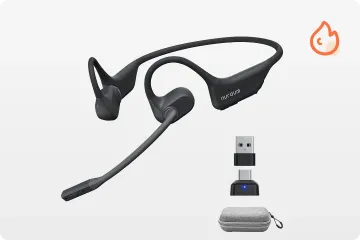
At 31 grams, it is among the lightest open-ear headsets with a dedicated microphone on the market. The ear-hook design keeps pressure off the ear canal while staying secure through a full workday. What sets it apart for calls is the HiFi 4 DSP paired with ENC (environmental noise cancellation) technology — the dual-microphone system actively filters out background noise so your voice comes through clearly, whether you are in a home office, a coffee shop, or a busy open-plan workspace. For professionals evaluating a best wireless headset with mic for work that preserves environmental awareness, the OpenEar Pro 2's combination of open-ear design and ENC noise cancellation is a compelling alternative to traditional closed-back office headsets.

The OpenEar Pro 2 also includes a USB-A/C dongle for an instant, drop-free connection to PCs and Macs, plus Bluetooth 5.4 with multipoint support so you can stay connected to your laptop and phone simultaneously. Battery life reaches 15 hours for music or 12 hours of talk time — enough to get through a full workday and a commute without reaching for a charger. The included carrying case makes it practical for professionals who move between home, office, and travel.
For users who want an open ear wireless headphone with microphone that handles calls as well as it handles music, the OpenEar Pro 2 sits at a compelling price point of 129(regularly149.99) — significantly less than premium alternatives like the Bose Ultra Open or Shokz OpenFit Pro, while still delivering the core features that matter most: comfort, call clarity, and all-day battery life. If you have been searching for the best wireless headset for work that does not force you into the isolation of a closed-back design, the OpenEar Pro 2 makes a strong case for going open-ear.
FAQs
What is the main difference between open-ear and bone conduction headphones?
Open-ear headphones use air conduction — a small speaker positioned near the ear canal sends sound through the air to your eardrum, just like natural hearing. Bone conduction headphones use transducers that vibrate against your cheekbones, sending sound through your skull bones directly to the cochlea, completely bypassing the eardrum.
Are open-ear headphones better for your ears than in-ear headphones?
Open-ear headphones keep the ear canal ventilated and unobstructed, which can reduce the risk of earwax compaction and external ear canal irritation compared to in-ear headphones. However, because they provide no passive noise isolation, users may be tempted to raise the volume in noisy environments, which can pose a hearing risk. The key is to monitor listening volume, especially in loud settings.
Which is better for running: open-ear or bone conduction headphones?
Bone conduction headphones are generally preferred for high-impact running and cycling because their wraparound neckband design is more stable and they typically offer higher IP ratings for sweat and rain resistance. Open-ear air conduction headphones are better suited for gym workouts, yoga, and casual jogging where sound quality matters more than maximum stability.
Do open-ear headphones have good bass?
Open-ear air conduction headphones generally deliver better bass than bone conduction models. Air conduction can reach lower frequencies (around 40 Hz) with more natural resonance, while bone conduction typically rolls off around 50 Hz and lacks the physical "thump" sensation. Premium open-ear models with large drivers and DSP tuning close the gap with traditional earbuds.
Can people around me hear what I'm listening to with open-ear headphones?
Sound leakage varies by model and technology. Premium open-ear headphones with directional audio and beamforming technology can reduce leakage by over 90% at moderate volumes. Bone conduction headphones can leak sound through chassis vibration at high volumes. In both cases, at normal listening levels in a quiet office, bystanders typically cannot make out your audio content.