




































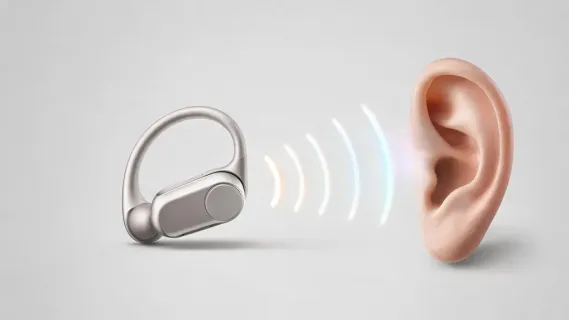
Open-ear headphones are changing the way we think about personal audio. Instead of sealing your ears, they deliver sound through advanced air conduction or bone conduction technology while keeping your ears open to the environment. This guide explains how open-ear headphones work, whether they are safer and more comfortable than traditional designs, how they perform for calls, and what features to look for when choosing an open-ear wireless headset with a microphone.
Key Takeaways
- Open-ear headphones deliver sound without blocking the ear canal, allowing users to stay aware of their surroundings.
- They use two main technologies: bone conduction and air conduction for a more comfortable listening experience.
- Situational awareness, all-day comfort, and glasses-friendly design make open-ear headphones ideal for active users.
- For calls and meetings, choose models with ENC microphones, DSP processing, and Bluetooth + USB dongle connectivity.
- Nuroum OpenEar Pro 2 combines 31g lightweight comfort, AI noise cancellation, and open-ear communication for work and daily use.
How Do Open-Ear Headphones Work? A Complete 2026 Guide
If you have ever wondered how do open ear headphone work without ever sitting inside your ear canal, you are not alone. Open-ear headphones have quietly become one of the fastest-growing categories in personal audio, showing up on morning joggers, warehouse floors, busy call centers, and Zoom-ready home offices. Unlike traditional in-ear buds or cushioned over-ear cans, they leave your ear fully open to the world around you.
That openness is the whole point. By keeping the ear canal unobstructed, open-ear designs let you listen to music, take calls, and follow a podcast while still hearing traffic, colleagues, and the doorbell. This guide breaks down the technology behind open-ear audio, explains whether open-ear headphones are safer and more comfortable (especially for glasses wearers), and helps you decide whether this style fits your daily routine.
How Do Open-Ear Headphones Work?
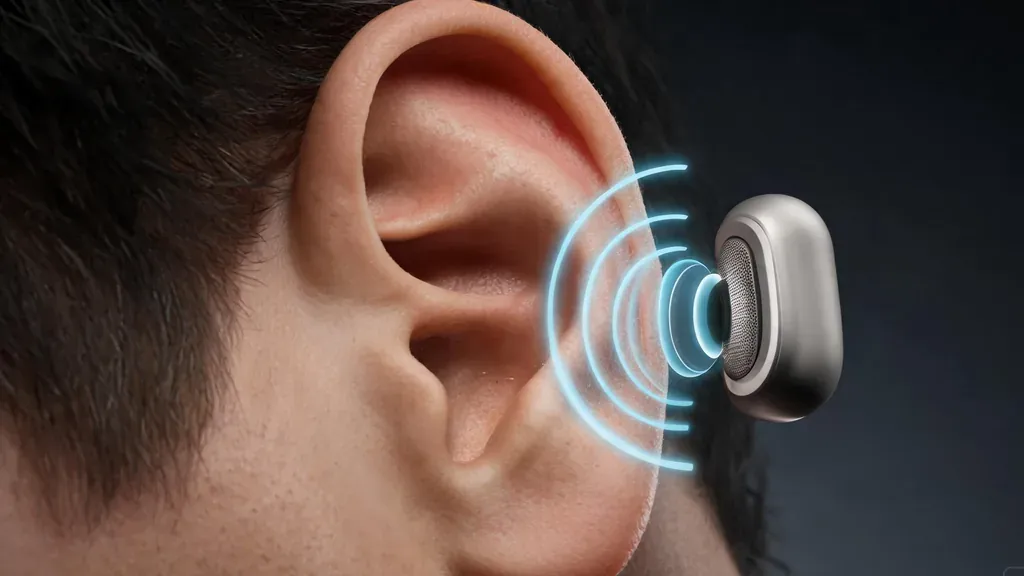
To understand how do open ear headphone work, it helps to know that "open-ear" is really a family of two distinct technologies that share one goal: delivering sound without sealing the ear.
- Bone conduction. Bone conduction headphones bypass the ear canal and eardrum entirely. A transducer rests against your cheekbone (the temporal bone) and converts audio into tiny mechanical vibrations. Those vibrations travel through the skull directly to the cochlea — the spiral-shaped inner-ear structure that turns vibration into the electrical signals your brain interprets as sound. Because nothing enters or covers the ear, you hear your surroundings perfectly. The trade-off is that bone-conduction audio can feel "thin," with weaker bass, because it never moves air the way a conventional speaker does.
- Air conduction (directed sound). Air-conduction open-ear headphones take a different path. They use small, angled speakers positioned just outside the ear opening. Instead of sealing the canal, the drivers beam a focused cone of sound waves toward the ear — much like a tiny, precisely aimed personal speaker. Technologies such as Shokz's DirectPitch tune the pressure field around the driver so that audio reaches your ear clearly while very little escapes outward. The result is fuller, more natural sound than bone conduction typically offers, again without blocking the ear.

The key engineering challenge in both approaches is sound leakage control. Because the ear is open, designers use directional acoustic chambers, phase cancellation, and tuned baffles to keep audio focused on the listener and private to people nearby, as shown in Figure 3. Modern open-ear models have narrowed the "everyone hears your music" problem dramatically, though they will never be as isolated as sealed in-ear monitors.
Are Open-Ear Headphones Safer?
The question "are open ear headphone safer" comes up for good reason, and the answer is nuanced. Open-ear headphones improve safety in two important ways, but they are not a license to ignore volume.
Situational awareness. This is the clearest safety advantage. Because the ear canal stays open, you continue to hear ambient sound at near-natural levels — approaching vehicles, cycling bells, a coworker calling your name, a smoke alarm. For runners, cyclists, commuters, and anyone moving through shared spaces, that continuous environmental awareness can prevent the accidents that sealed earbuds are notorious for causing. Safety advocates have long warned that noise-isolating headphones reduce a pedestrian's ability to detect oncoming traffic; open-ear designs directly address that risk.

Hearing health. There is a second, less obvious benefit. Traditional in-ear buds create a sealed chamber that can amplify damaging sound pressure against the eardrum, and the isolation they provide tempts users to crank the volume higher to overcome outside noise. Open-ear headphones, by contrast, mix your audio with ambient sound, so your brain has a natural loudness reference and you are less inclined to push volume into harmful territory. That said, any headphone played loud enough for long enough can damage hearing — openness reduces but does not eliminate the risk.
In short: open-ear headphones are safer for situational awareness and gentler on hearing when used responsibly, but you should still keep volume moderate and take listening breaks.
Are Open-Ear Headphones Comfortable for Glasses Wearers?
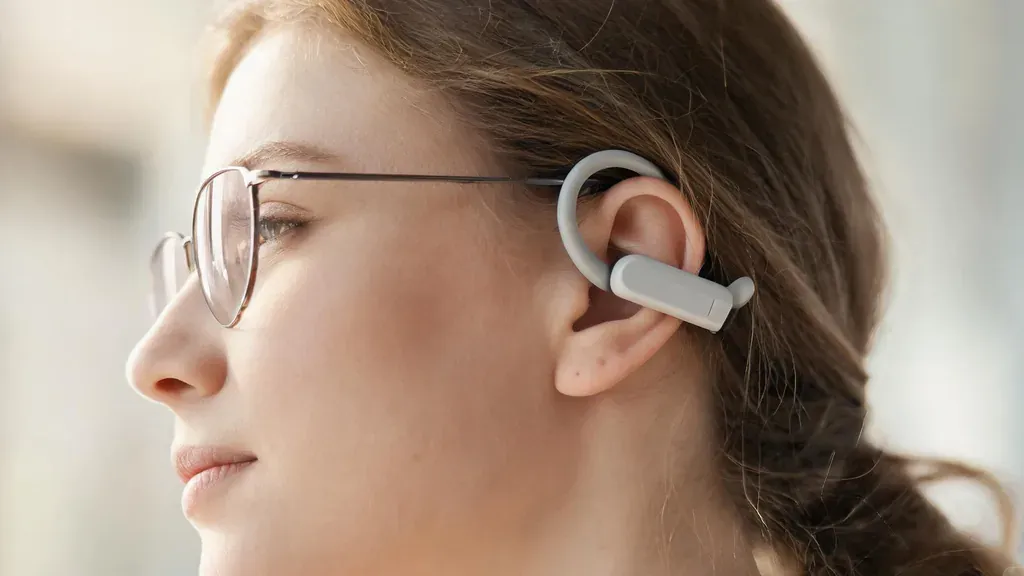
If you wear glasses, you already know the headphone struggle: over-ear cushions press the temples of your frames into the side of your head, and in-ear buds can irritate after an hour. So are open-ear headphones a good open ear headphone for glasses wearers? For most people, yes — with one design detail to watch.
Open-ear headphones come in two physical styles. The first uses a flexible band or hook that wraps over the ear, keeping the driver suspended just outside the ear opening. This style generally avoids the temples entirely, so it barely interacts with your glasses. The second is an open-ear clip or bud that sits in the concha (the bowl of the ear) without entering the canal; it also tends to leave glasses alone.
The comfort advantage is real: no clamping force on the head, no cushion pressure driving frames into your skin, and no ear-canal fatigue. The main thing to verify is that the over-ear hook does not overlap your glasses temple tip where it curves behind the ear — most modern open-ear hooks are slim enough that the two coexist comfortably, but trying the fit is worthwhile if you wear thick frames.
Key Features to Look for in Open-Ear Wireless Headphones with Microphone
Not every open-ear model is built for communication. If your priority is calls and meetings, here is what separates a capable open ear wireless headphone with microphone from a basic music-only pair.
- Microphone quality and noise cancellation. Look for dual or multi-microphone arrays with Environmental Noise Cancellation (ENC) and a DSP chip. These pick up your voice while suppressing keyboard clatter, traffic, and café chatter — essential for professional calls.For anyone who regularly takes calls from unpredictable acoustic environments, the best headphones for calls in noisy environment demonstrate how advanced ENC and directional mic arrays preserve call clarity even when the world around you is anything but quiet.
- Connectivity. Bluetooth 5.3 or 5.4 gives stable, low-latency audio. Even better is a model that includes a USB-A/C dongle, which provides a rock-solid link to a PC or Mac and sidesteps the Bluetooth quirks of video-conferencing apps.When shopping for the best wireless headset for work, prioritize models that include a USB dongle for PC reliability alongside Bluetooth multipoint.
- Multipoint pairing. The ability to connect to two devices at once lets you switch from a laptop meeting to a phone call without re-pairing.
- Battery life. Aim for at least 10–12 hours of talk time for all-day use; 15 hours or more means you can go a full workday plus an evening walk without charging.
- Sound leakage control. A well-engineered acoustic chamber keeps your audio private in shared offices — check for anti-sound-leakage or directional-audio features.
- Weight and controls. Under 35 grams is ideal for forget-you're-wearing-it comfort. On-device mute and volume buttons are far more practical than fumbling for your phone mid-call.
If you want a model that doubles as a daily open ear headphone with mic, prioritize the microphone and connectivity points above all else.
Open-Ear vs. Traditional Headphones: What's the Difference?
The fastest way to decide if open-ear is right for you is to line it up against the styles you already know.While the best headsets for work span all three categories, understanding how each design trades off isolation, comfort, and awareness helps you match the right style to your daily routine.
| Feature | Open-ear | In-ear earbuds | Over-ear headphones |
|---|---|---|---|
| Ear canal blocked | No | Yes | No (but ear covered) |
| Ambient awareness | High | Very low | Low |
| Sound isolation | Low | High | High |
| Bass response | Moderate | Strong | Strongest |
| Long-wear comfort | Excellent | Fair (fatigue) | Good (clamping) |
| Best for | Calls, outdoor activity, awareness | Isolated listening, travel | Immersive music, studio |
Open-ear headphones win on awareness and all-day comfort, and they make excellent wireless open ear headphone options for people who need to stay reachable. They trade away the deep bass and noise isolation that in-ear and over-ear models provide, so they are not the best pick for a noisy flight or critical music listening — but for communication, safety, and comfort, they are in a class of their own.
Who should choose open-ear? The design shines for a few specific readers. Commuters and outdoor athletes benefit from uninterrupted environmental awareness. For agents and support teams in high-density environments, the best call center headset with noise cancelling microphone often comes down to a choice between sealed isolation and open-ear awareness — and open-ear is increasingly winning that debate.Office and remote workers who take back-to-back calls value the all-day comfort and clear microphones. Glasses wearers escape the temple pressure of traditional headsets.

Nuroum OpenEar Pro 2: An Open-Ear Communication Solution for Work and Daily Use
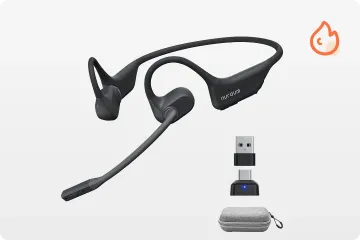
When the goal is a comfortable, call-ready open-ear headset, the Nuroum OpenEar Pro 2 is built specifically for that intersection of communication and comfort. Weighing just 31 grams, it uses an air-conduction open-ear design that leaves the ear canal fully open, so you stay aware of your surroundings during calls, commutes, or shifts.
What makes it stand out as an open ear wireless headphone with microphone is its communication engineering. Dual noise-cancelling microphones paired with a HiFi 4 DSP chip and ENC technology strip away background noise so the person on the other end hears your voice, not your environment — whether you are in a busy open office, a warehouse, or a kitchen with kids. Bluetooth 5.4 with an included USB-A/C dongle delivers a stable, low-latency connection across PC, Mac, and phone, and multipoint pairing lets you jump between a Teams meeting and a mobile call seamlessly.
Battery life is another strength: up to 12 hours of talk time or 15 hours of music on a single charge, with a full recharge in two hours via USB-C. An on-headset mute button with discreet in-ear voice prompts means you can silence yourself without broadcasting a beep to clients, and anti-sound-leakage technology keeps your conversations private. A compact carrying case rounds it out for professionals on the move.

For glasses wearers, the lightweight over-ear-hook design avoids the temple pressure that makes traditional headsets painful over a long day. The result is a headset that works equally well for remote workers, teachers, warehouse managers, and commuters — anyone who needs clear calls without losing touch with the world around them. If you are hunting for the best open ear headset with mic, the OpenEar Pro 2 is a strong, well-priced contender, and it doubles as an everyday open ear headphone bluetooth for music and podcasts between meetings.
Open-ear headphones are not a gimmick — they are a genuinely different way to listen, built around two proven technologies and a simple philosophy: your ears should stay open to the world. Whether you are fielding calls, logging miles on a trail, or simply tired of ear-canal fatigue, understanding how the technology works helps you choose a pair that fits your life instead of fighting it.
FAQs
How do open-ear headphones work without going inside your ear?
They use either bone conduction (vibrations sent through your cheekbones to the inner ear) or air conduction (small directional speakers that beam sound toward the ear opening). Neither seals the ear canal, so ambient sound passes through naturally.
- Are open-ear headphones safer than regular earbuds?
They are safer for situational awareness because you can hear traffic and people around you, and they are gentler on hearing because the open design discourages high volumes. You should still keep volume moderate and take breaks.
- Can you wear open-ear headphones with glasses?
Yes. Most open-ear models use an over-ear hook or clip that avoids the temples, so they coexist comfortably with glasses. Just check that the hook does not overlap thick temple tips behind the ear.
- Are open-ear headphones good for phone calls?
They can be, if you choose a model with noise-cancelling microphones and a DSP chip. A purpose-built bluetooth headphone open ear headset like the Nuroum OpenEar Pro 2 is designed specifically for clear voice communication in noisy environments.